ExSoil Summer School 2026 – Call for Applications
Event Date: –Location: Saken Seiffulin Kazakh Agrotechnical University, Astana and A.I. Baraev Scientific and Production Centre for Grain Farming, Shortandy, KazakhstanApplications are now open for the ExSoil Summer School 2026: Soil Erosion and Land Degradation in Drylands and Fragile Landscapes under Climate Change, taking place from 25–31 July 2026 in Astana and Shortandy, Kazakhstan. The summer school is organized by the ExSoil Competence Network for Soil Science in Central Asia and Mongolia, Leibniz University Hannover, and Martin Luther University Halle-Wittenberg, in cooperation with Saken Seifullin Kazakh Agrotechnical Research University and the A.I. Baraev Scientific and Production Centre for Grain Farming.
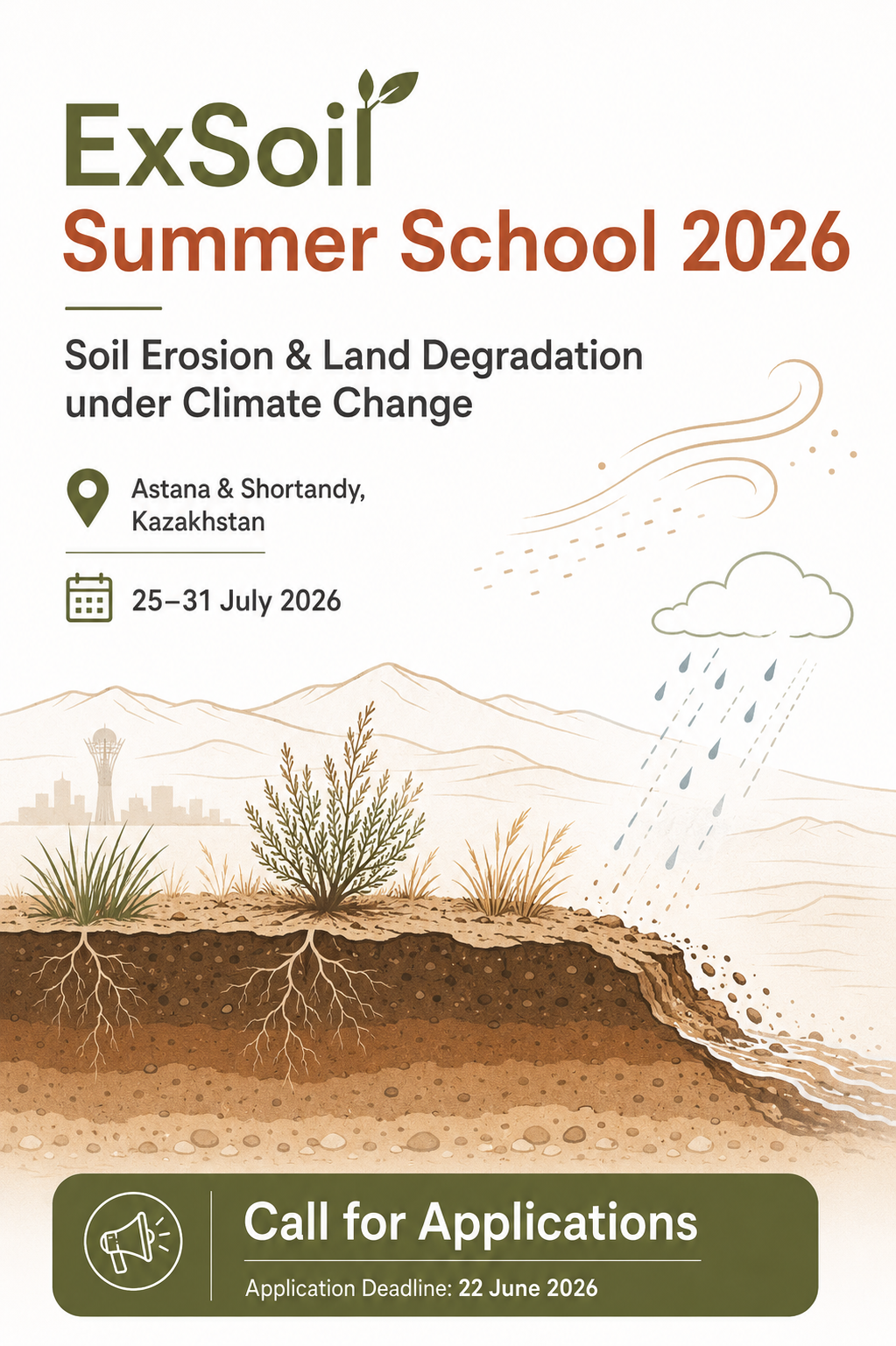
International Summer School on soil erosion and land degradation in drylands and fragile landscapes under climate change
Venue: Saken Seiffulin Kazakh Agrotechnical University, Astana and A.I. Baraev Scientific and Production Centre for Grain Farming, Shortandy, Kazakhstan
Dates: 25–31 July 2026
Working language: English
ABOUT THE SUMMER SCHOOL
Drylands and fragile landscapes of Central Asia are increasingly affected by climate change, unsustainable land use, and soil degradation. Wind and water erosion, loss of soil organic matter, declining biodiversity, and other degradation processes threaten both agricultural productivity and ecosystem resilience.
This international summer school will provide participants with a unique opportunity to explore how soil degradation and erosion can be assessed using complementary field and experimental approaches. Through field investigations, laboratory analyses, wind tunnel and rainfall simulation experiments, participants will gain hands-on experience in evaluating soil properties, erosion susceptibility, and the effects of land use and management history on soil resilience.
The programme combines lectures, field training, laboratory practicals, and group work, using the long-term experimental fields of the A.I. Baraev Scientific and Production Centre for Grain Farming as a living laboratory for studying soil degradation processes in dryland environments.
WHY PARTICIPATE?
Participants will have a unique opportunity to learn from leading international scientists and experts in soil science, land degradation, and sustainable land management. The programme combines state-of-the-art scientific knowledge with hands-on training in modern field, laboratory, and experimental methods used to assess soil erosion and degradation processes.
Participants will gain practical experience with:
- Field assessment of soil properties and erosion susceptibility
- Portable wind tunnel experiments for evaluating wind erosion processes
- Rainfall simulation experiments for assessing water erosion risks
- Laboratory analyses of soil physical properties and aggregate stability
- Modern approaches for environmental monitoring, GIS, and remote sensing applications
WHAT MAKES THIS SUMMER SCHOOL UNIQUE?
Unlike conventional classroom-based training courses, the programme is built around field observations, experimental investigations, and long-term agricultural experiments. Participants will explore how different land-use systems and management histories influence soil properties, erosion susceptibility, and land degradation processes, while gaining first-hand experience with research methods widely used in contemporary soil and environmental sciences.
TOPICS
- Soil health and ecosystem resilience
- Wind and water erosion processes
- Soil physical properties and erosion susceptibility
- Field assessment of soil degradation indicators
- Wind tunnel experiments
- Rainfall simulation experiments
- Land-use and management effects on soil degradation
- Sustainable land management in dryland environments
- Introduction to GIS and remote sensing applications for erosion assessment
WHO CAN APPLY?
- MSc students
- PhD candidates
- Early-career researchers
- Young professionals working in soil science, agronomy, environmental sciences, geography, ecology, land management, or related disciplines
Applicants from Kazakhstan, Kyrgyzstan, Uzbekistan, Tajikistan, and Mongolia are particularly encouraged to apply.
FINANCIAL SUPPORT
A limited number of travel grants will be available through the ExSoil project.
Up to 8 selected participants will receive financial support covering:
- Travel to and from the summer school venue
- Accommodation during the summer school
- Meals and local transportation related to programme activities
Priority for travel grants will be given to applicants from Central Asia and Mongolia based on academic merit, motivation, and demonstrated need for financial support.
Additional participants may be admitted without financial support, subject to available capacity.
SELECTION PROCESS
Participation is competitive. Applicants with full financial support will be selected based on:
- Academic background and research interests
- Motivation to participate
- Relevance of the summer school to their current studies or research activities
- Potential contribution to soil science and sustainable land management in Central Asia
In addition, further participants can attend the summer school at own costs for travelling, accommodation, and meals. No further fees will apply.
APPLICATION PACKAGE
- CV including current institution, degree programme, and research interests (maximum 2 pages)
- Motivation letter (maximum 1 page)
SUBMISSION OF APPLICATIONS
- Application documents should be submitted by email to:
Dr. Olga Shibistova
Leibniz University Hannover, Germany
olgas@ifbk.uni-hannover.de
- Applicants are requested to submit all application documents as a single PDF file.
- Application deadline: 22 June 2026
- Notification of selected participants: 30 June 2026
ORGANIZERS
- ExSoil – Competence Network for Soil Science in Central Asia and Mongolia
- Leibniz University Hannover (Germany)
- Martin Luther University Halle-Wittenberg (Germany)
HOSTED IN COOPERATION WITH
- Saken Seifullin Kazakh Agrotechnical Research University (Kazakhstan)
- A.I. Baraev Scientific and Production Centre for Grain Farming (Kazakhstan)