Science in Kazakhstan is developing within the strategy of transitioning to a knowledge-based economy, where integration of science, education, and industry plays a key role, along with support for priority areas such as AI, biomedicine, green technologies, and water security. A central position in the system is held by the National Academy of Sciences of the Republic of Kazakhstan, under the coordination of the Ministry of Science and Higher Education, although R&D funding (around 0.16% of GDP) remains low and requires further increase to meet international standards.
Overview: The system of science in Kazakhstan
| Territory | 2.724.900 km2 |
|---|---|
| Population | 20.370 million |
| Capital | Astana |
| Languages | Kazakh, Russian |
| GDP | $ 274.46 billion |
| Research priorities | Energy transition and renewable energy Environment, climate, and natural resource management Digitalization, innovation, AI, Urban development, industrial policy, economic diversification |
In the Presidential Address of September 8, 2025, President Kassym-Jomart Tokayev set a key national priority: to transform science, education, and innovation into the main driver of Kazakhstan’s knowledge-based economy. The National Academy of Sciences fully supports this strategic vision and is already implementing practical steps toward achieving it.
To ensure that scientific research addresses real national needs, the Academy conducted Kazakhstan’s first large-scale foresight study together with scientists, industry, and government stakeholders. As a result, 210 priority scientific and technological tasks were identified in fields such as AI, biomedicine, green technologies, and water security. These priorities must be regularly updated to guide long-term funding and policy decisions.
A crucial requirement for successful implementation is integration between science, education, and industry. We support the President’s proposal to unite innovation policy under the Ministry of Science and Higher Education, enabling a continuous chain from fundamental research to applied solutions and commercialization. The Academy has already designed pilot interdisciplinary programs with clear timelines, indicators, industrial partners, and commercialization pathways.
Research universities will play a central role, especially those with strong AI and engineering schools, modern laboratories, and active technology-transfer ecosystems. Universities focused on AI should receive greater autonomy, targeted grants, access to data, computing resources, and joint labs with industry.
Human capital remains the foundation. Kazakhstan must create attractive conditions for young scientists, expand grant and housing programs, and launch initiatives to bring back Kazakh researchers working abroad while attracting leading international experts.
Effective implementation requires competent leadership. The Academy proposes expert review of candidates for rector and director positions to ensure scientific credibility and managerial capability.
The President has provided clear strategic direction. Our shared task is to turn this vision into action. Through systematic work, strong partnerships, and investment in people, Kazakhstan can build a competitive scientific ecosystem and strengthen its position as a regional leader in knowledge and innovation. source https://qazscience.gov.kz
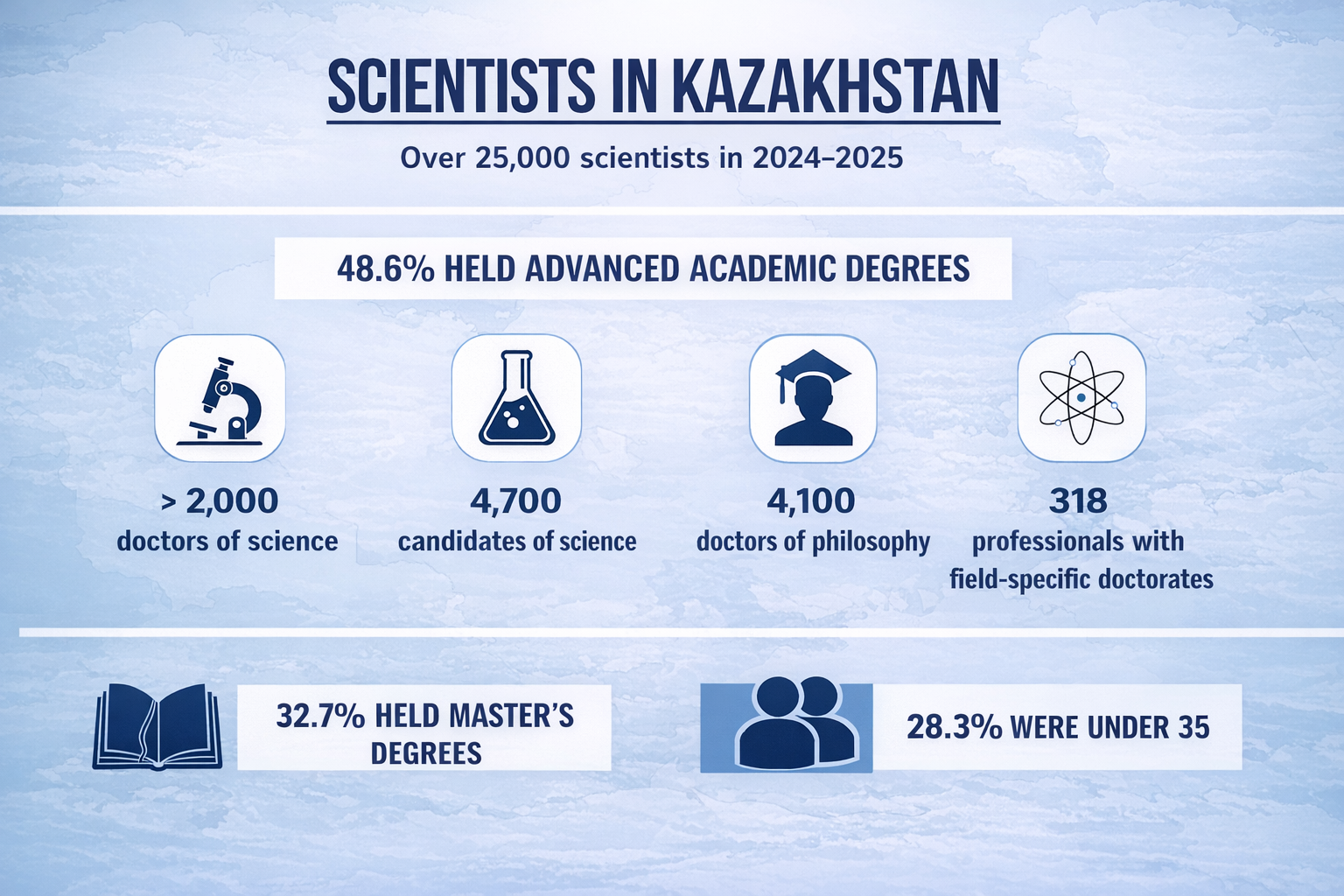
According to the Bureau of National Statistics, more than 25,000 scientists were working in Kazakhstan in 2024–2025. Of these, 48.6% held advanced academic degrees, including over 2,000 doctors of science, 4,700 candidates of science, 4,100 doctors of philosophy, and 318 professionals with field-specific doctorates. Roughly a third of all researchers (32.7%) held master’s degrees, and 28.3% were under the age of 35(figure 1).
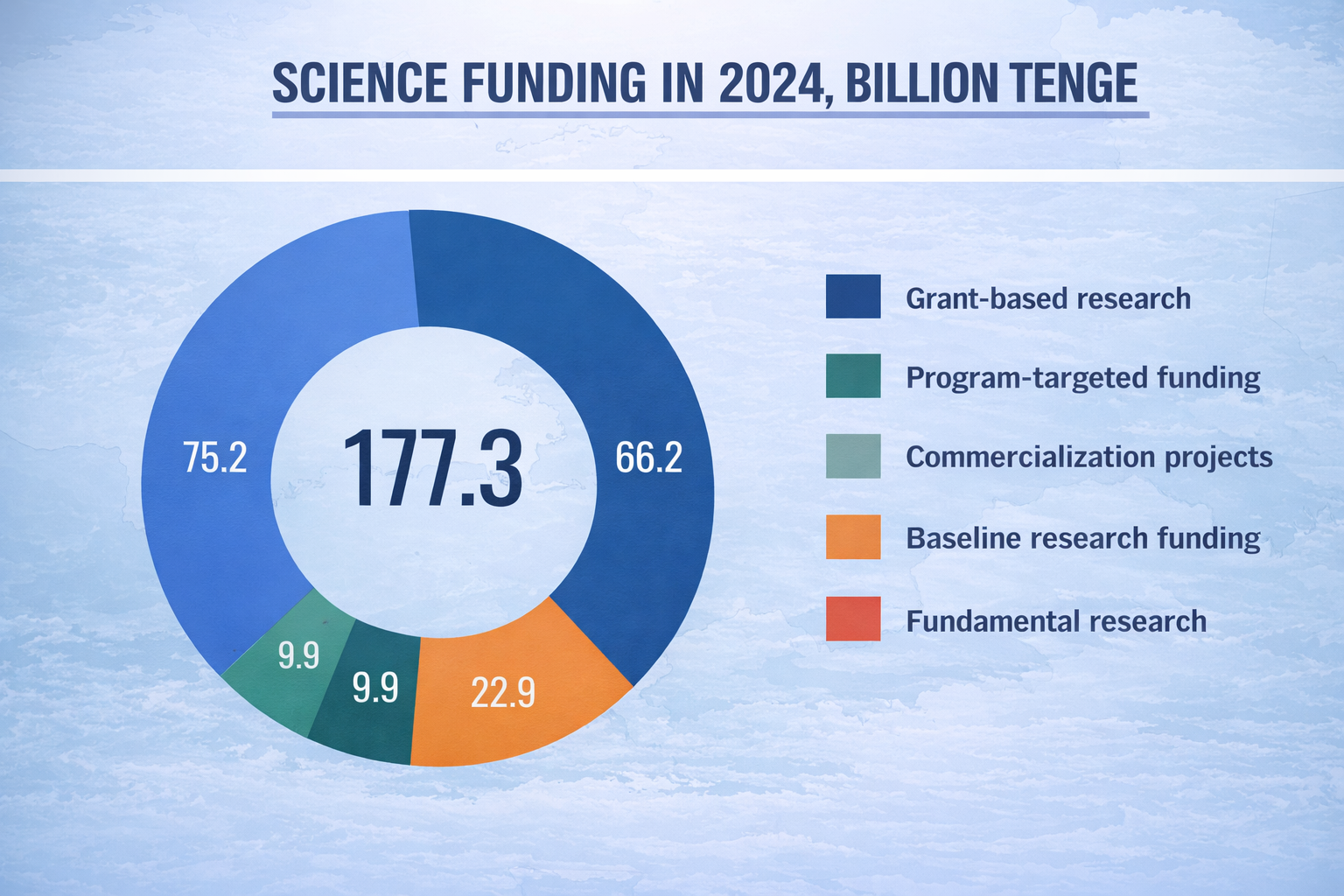
In 2024 alone, 177.3 billion tenge (US$343 million) was allocated from the national budget to support science. This includes 66.2 billion tenge (US$128 million) for program-targeted funding, 75.2 billion tenge (US$145 million) for grant-based research, 22.9 billion tenge (US$44.2 million) for commercialization projects, 9.9 billion tenge (US$19 million) for baseline research funding, and 3.1 billion tenge (US$5.9 million) for fundamental research(figure 2)
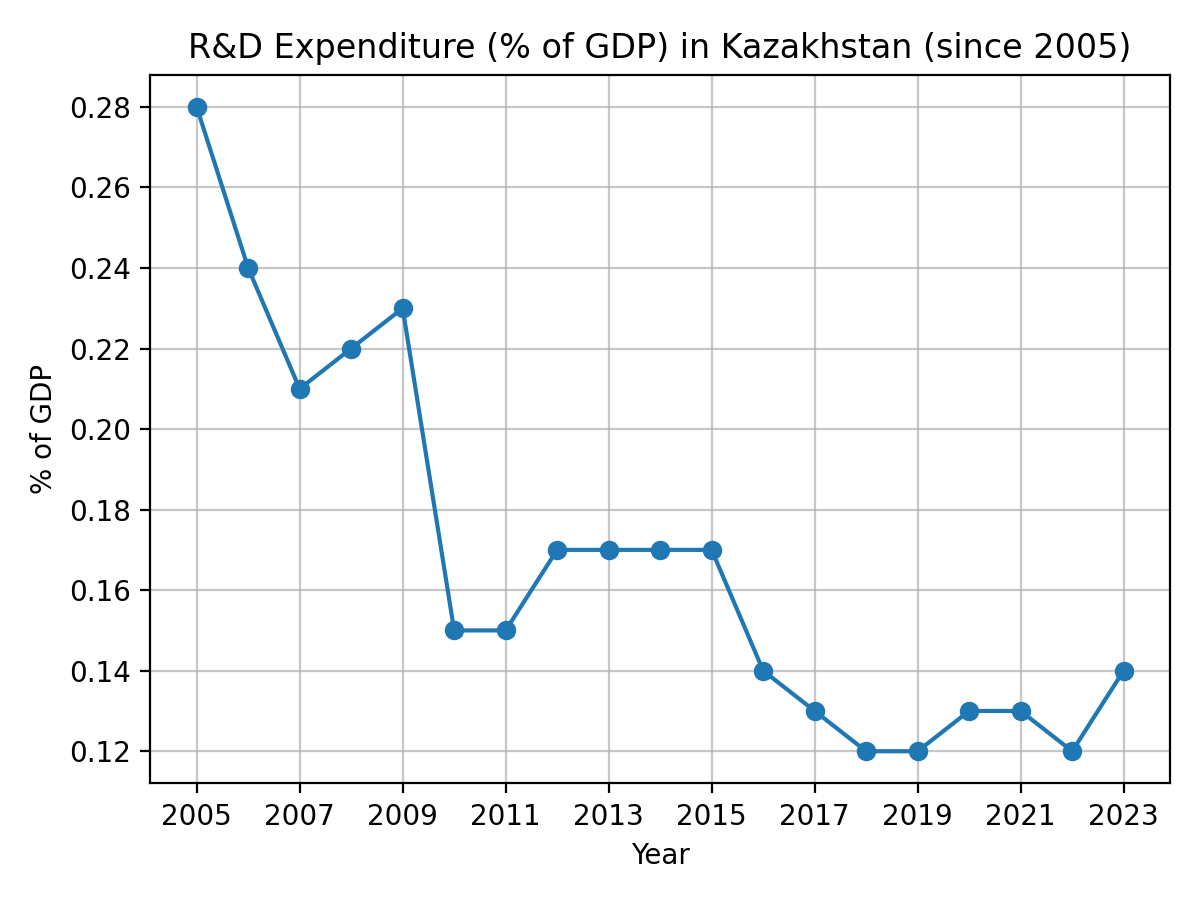
Research and development expenditure, percent of GDP
In Kazakhstan R&D (research and development) spending remains just 0.16% of GDP. Kazakhstan ranks 124th globally in science investment according to the 2024 Research and Development Expenditure data from the UNESCO Institute for Statistics. By comparison, Israel invests 5.56% of its GDP in R&D, followed by South Korea at 4.93%, the United States at 3.46%, Belgium at 3.43%, and Sweden at 3.42%. Kazakhstan aims to reach the global benchmark of 1% of GDP in R&D spending.
In 2023, Kazakhstan’s expenditures on R&D (research and experimental development) amounted to 0.14% of GDP. In 2022, they were 0.12% of GDP(figure 3).
Forms of financing:
-Zhas Galym Program (EOM RK)
-General Grant Competition (Science Committee)
-Targeted programs
Topics of priority areas for all the grants :
- Renewable energy
- Rational use of resources
- Medicine and biotechnology
- ICT and digitalization
- Agricultural technologies and food security
Key authorities:
1. Ministry of Science and Higher Education of the Republic of Kazakhstan (MSHE RK)
The main governmental authority responsible for developing and implementing national policies in science, higher education, and research. It oversees research programs, grant funding schemes, universities, and research institutions.https://www.gov.kz
2. Science Committee of the MSHE RK
Manages state research programs, coordinates scientific organizations, and is responsible for the evaluation and monitoring of research projects.https://www.gov.kz
3. National Academy of Sciences of the Republic of Kazakhstan (NAS RK)
The leading scientific institution in the country, bringing together academic institutes and researchers. It promotes fundamental research, provides scientific expertise, and advises government authorities.( Figure 4).https://qazscience.gov.kz
4. Science Fund (JSC “Science Fund”)
The national operator for the commercialization of scientific results. It supports startup projects, technology transfer, applied research, and the integration of research outputs into the economy..https://science-fund.kz
5. National Center for State Scientific and Technical Expertise (NCSSTE)
Conducts scientific and technical evaluation of projects and assesses applications for grant and program-based funding.https://www.ncste.kz/
6. National Scientific Council (NSC)
An advisory expert body responsible for defining national research priorities and participating in the selection of state-funded research programs.
National Academy of Sciences of the Republic of Kazakhstan (NAS RK)
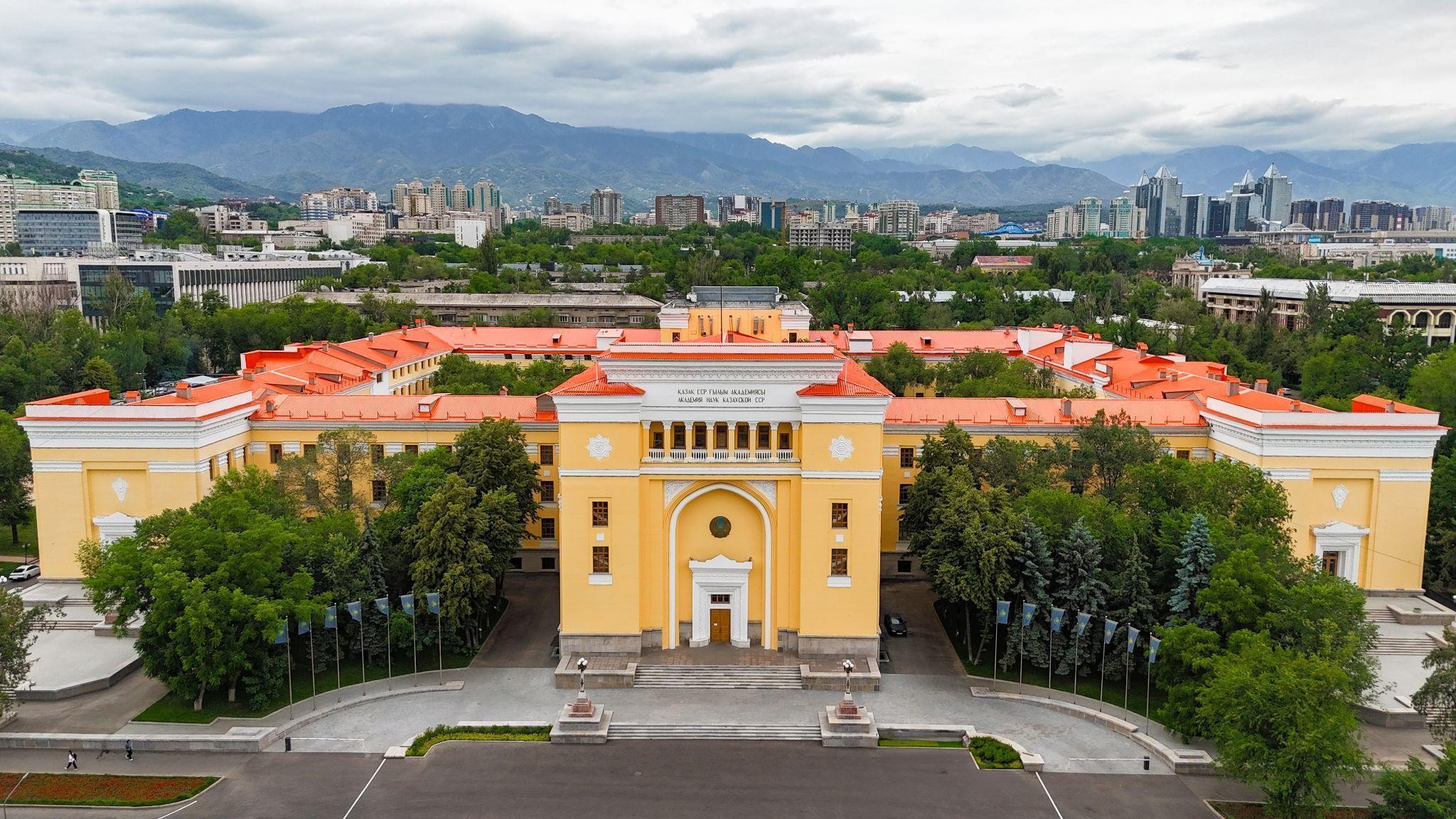
In 2022, the National Academy of Sciences was restored to its state status. This was stated by President of the Republic of Kazakhstan Kassym-Jomart Tokayev, speaking on June 1, 2022 at the jubilee session of the National Academy of Sciences dedicated to the 75th anniversary of the organization.: https://qazscience.gov.kz/en
The Academy is an association of leading scientists of the Republic of Kazakhstan in order to conduct scientific and analytical research to solve strategically important problems of the economy and society, determine priority areas for the development of science in the Republic of Kazakhstan and participate in the development and implementation of state policies in scientific, technical and other areas based on objective, scientifically based data.
To date, the number of universities in the country is 120, including 11 national universities, 29 state – owned (non – profit joint – stock companies), 1 international university, 16 corporatized universities, 48 private universities, 1 autonomous University (Nazarbayev University), and 14 non – citizen universities.
Leading universities in Kazakhstan:
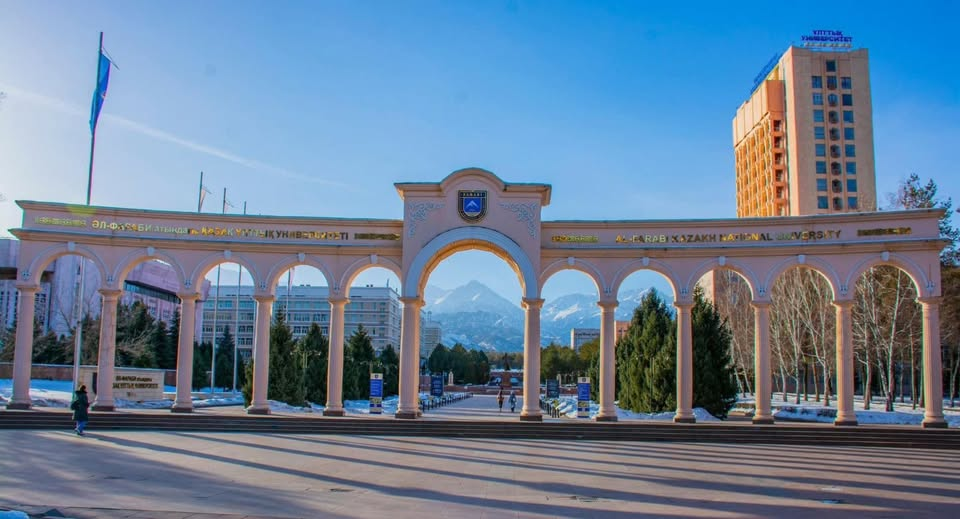
- Al-Farabi Kazakh National University. The largest classical university in Kazakhstan; leading in natural sciences, international relations, IT, chemistry, and biology. https://www.kaznu.kz(figure 5)
- L. N. Gumilyov Eurasian National University. A flagship state research university in Astana with strong programs in engineering, political science, energy, IT, and humanities. https://www.enu.kz
- Kazakh National Research Technical University named after K. SatpayevKazakhstan’s leading engineering and technical university: mining, oil & gas, IT, geology, architecture.
- https://satbayev.university
- M. Auezov South Kazakhstan UniversityA large multidisciplinary university in Shymkent with strong agricultural, engineering, chemical, and pedagogical programs.
- https://auezov.edu.kz
- Abay Kazakh National Pedagogical UniversityThe first pedagogical university of Kazakhstan; a major center for teacher training, psychology, and linguistics.
- https://abaiuniversity.edu.kz
- Kazakh National Agrarian Research UniversityNational research university specializing in agriculture, water resources, agro-technologies, ecology, and food security.
- https://kaznaru.edu.kz
- Khoja Ahmet Yasavi International Kazakh-Turkish UniversityA Kazakh–Turkish international university in Turkestan offering programs in medicine, engineering, and humanities. https://ayu.edu.kz
- Karaganda Technical University named after Abylkas SaginovA strong engineering and mining university with programs in construction, transport, and industrial technologies.
- https://www.kstu.kz
- Karaganda University named after E. A. BuketovA major multidisciplinary university with strong programs in physics, economics, pedagogy, and humanities. https://ksu.edu.kz
- Almaty Technological University A leading institution in food technology, textile industry, design, and industrial technologies.https://atu.edu.kz
- D. Serikbayev East Kazakhstan Technical University A technical university in Ust-Kamenogorsk, known for engineering, IT, materials science, and energy.
- https://ektu.kz
- S. Asfendiyarov Kazakh National Medical University.The largest medical university in the country, training doctors, pharmacists, and biomedical specialists. https://kaznmu.kz
- Kazakh-British Technical University.An innovation-driven university with strong programs in oil & gas, IT, digital technologies, finance, and marine engineering; ranked for strong industry partnerships. https://kbtu.edu.kz
- Narkhoz UniversityA leading university in economics, finance, business administration, public policy, and data analytics. https://narkhoz.edu.kz
- KIMEP UniversityKazakhstan’s top private university in economics, management, law, public policy, and international relations. https://kimep.kz
- Abylai Khan Kazakh University of International Relations and World LanguagesThe main national university specializing in linguistics, translation, regional studies, and international relations.https://kazuir.edu.kz
- Saken Seifullin Kazakh Agrotechnical UniversityA national center for agricultural engineering, agro-technologies, and precision farming. https://kazatu.edu.kz
- Suleiman Demirel UniversityA private university known for strong IT, computer science, education, and business programs. https://sdu.edu.kz
- S. Toraigyrov Pavlodar UniversityA regional research and education center offering programs in engineering, materials science, energy, and pedagogy.
- https://tou.edu.kz
- Korkyt Ata Kyzylorda UniversityA multidisciplinary university in Kyzylorda with programs in education, engineering, economics, and agriculture.
- https://korkyt.edu.kz
- Taraz Regional University named after M. DulatiOne of the largest regional universities offering engineering, IT, agriculture, and environmental studies. https://dulaty.kz
- https://www.gov.kz/memleket/entities/sci/press/news/details/786682?lang=ru