Main funding opportunities include the German Research Foundation (DFG), Federal Ministry of Education and Research (BMBF), and Horizon Europe.
Overview: Main research funding programs in Germany and Europe
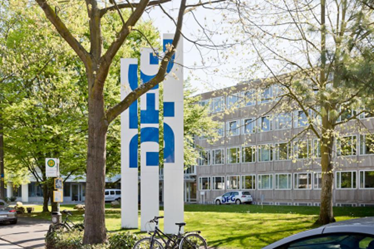
The DFG supports knowledge-driven research at the highest level, independent of political and economic interests. Funding is therefore open to all topics and is based solely on the quality of the application. Funding formats include individual projects, research groups, research training groups, collaborative research centres, clusters of excellence and infrastructure measures. Scientists and scientific institutions are eligible to apply. Funding for international collaborations is also available.
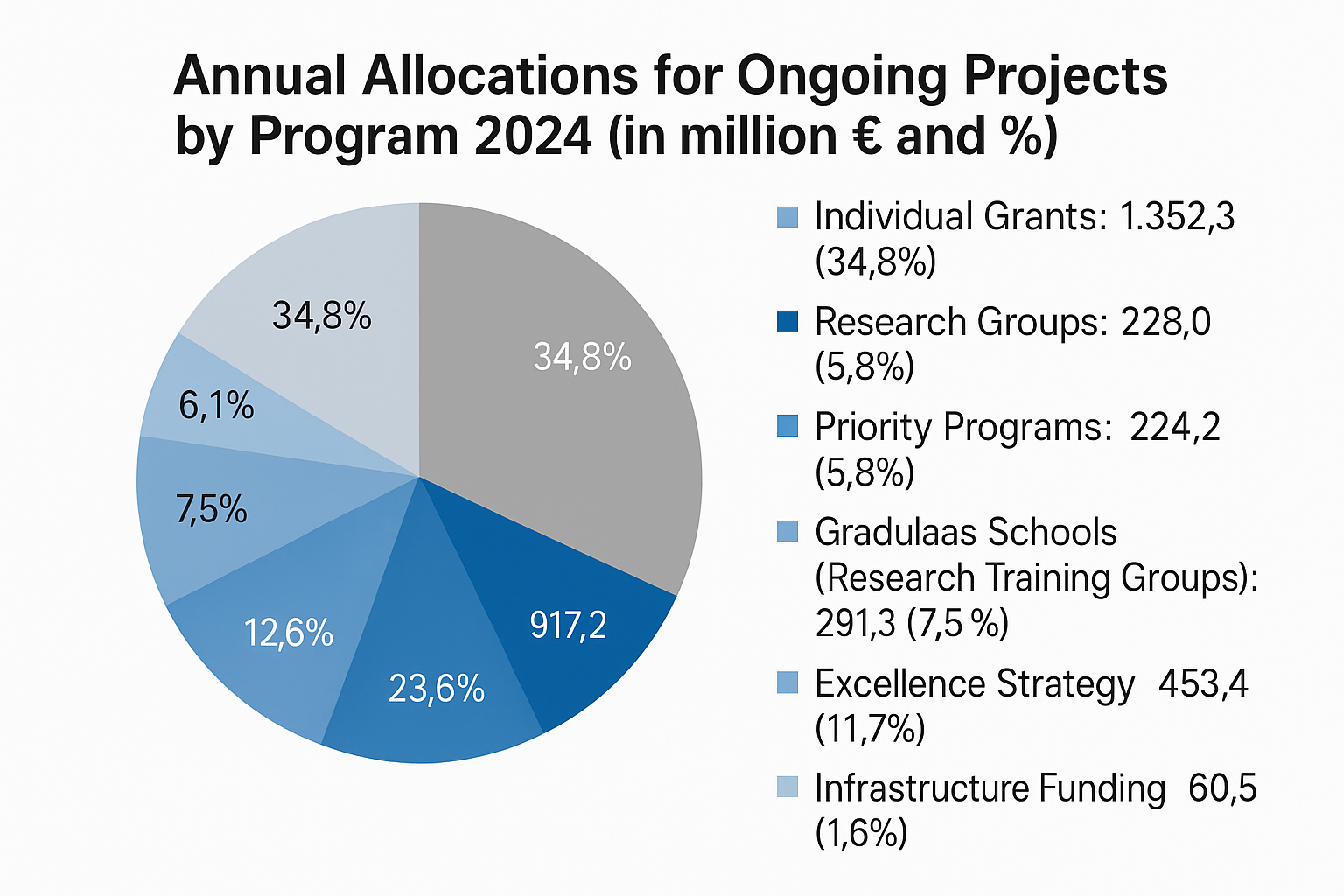
Funding: The DFG’s annual budget is approximately EUR 4 billion. The amount of funding for a project is not predetermined, but is based on its needs. Scientists with a doctorate and scientific institutions are eligible to apply. Scientific evaluation is carried out by peer review and is characterised by a high degree of transparency and quality standards
Programs
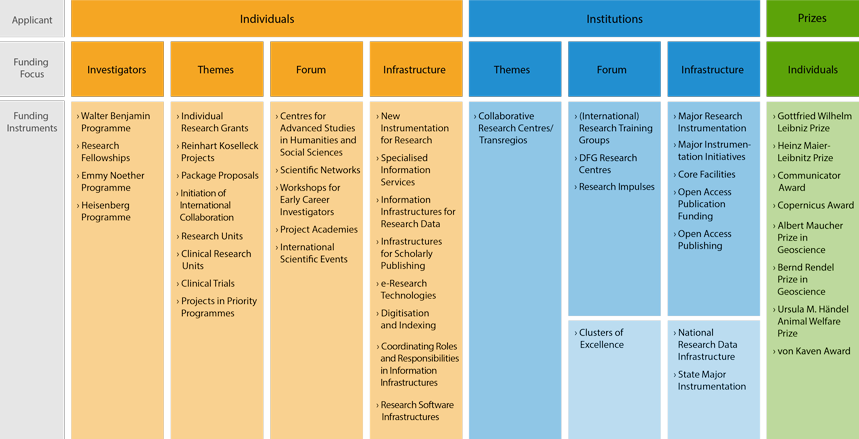
The DFG offers a wide range of funding programmes for knowledge-driven research – from individual projects and support for early-stage researchers to large collaborative structures. The application system distinguishes between application opportunities for researchers and application opportunities for organisations:
DFG funding portfolio
Individual funding (grants)
Individual funding (grants) accounts for the largest share of projects. Grants are used to support funding projects that are limited in terms of subject matter and duration. Scientists from all disciplines at German research institutions who have completed their scientific training are eligible to apply dfg.de.
The DFG enables research cooperations between researchers in Germany and in developing countries through research grants for individual projects. The aim is to promote scientific cooperation between Germany and developing countries within the framework of scientifically demanding research projects. The countries of Central Asia are eligible for support due to their status as developing countries.
All additional information dfg.de
The funding instrument ‘Initiation of International Cooperation’ serves to initiate international cooperation. To this end, support can be provided for ‘project preparation workshops’, ‘trips abroad’ and ‘visiting stays’ (information at dfg.de)
With the UDIF-HAW initiative (Support for Internationalisation at Universities of Applied Sciences), the DFG has been strengthening networking opportunities for universities of applied sciences with scientists from Central Asia, particularly Kazakhstan and Uzbekistan, since this year. Themed virtual matchmaking events provide an opportunity for professional exchange with scientists from these countries dfg.de
A list of all DFG funding opportunities can be found at dfg.de.
You can also find information on DFG-funded projects in the GEPRIS project database gepris.dfg
Prospective applicants can contact CASIB as the DFG’s regional representative.
BMFTR (German Federal Ministry of Research, Technology and Space)
The Federal Ministry of Education and Research (BMBF) supports research cooperation with Central Asia to jointly develop solutions to global challenges. Collaboration extends to the countries of Kazakhstan, Kyrgyzstan, Mongolia, Tajikistan, Turkmenistan, and Uzbekistan.
The overarching framework for cooperation with Central Asian countries is provided by the EU Strategy for Central Asia, “New Opportunities for a Stronger Partnership” (revised in 2019), to which Germany contributed significantly, the Global Gateway Initiative (2021), and the strategic regional partnership (2023) launched in 2023 to deepen regional cooperation. In addition, the Federal Foreign Office launched the Green Central Asia initiative in 2020, in which German research institutions are actively involved.
The cooperation aims to address regional needs, identify opportunities to achieve the United Nations’ Sustainable Development Goals (SDGs), and strengthen the resilience of regions particularly affected by climate change through knowledge transfer.
The thematic focuses of collaboration with the countries of Central Asia are closely based on the priorities of the EU’s new Central Asia strategy.
These include:
- land management and agriculture
- climate/environment research and adaptation to climate change
- water research and water management
- natural hazards and civil protection
- sustainable urban development
- biodiversity research
- bioeconomy research
- secure, clean and efficient energy
- health
Programs
1. Framework announcement on the funding of projects in research and innovation cooperation with the countries of the Eastern Partnership and Central Asia, announced 19 October 2023
A key element of the BMFTR’s funding strategy for Central Asia is the Framework call for the funding of projects in research and innovation cooperation with Eastern Partnership countries and Central Asia. This consists of nine funding modules, ranging from mobility support to the establishment of institutional partnerships.bmftr.bund.de
The following objectives are set out in the announcement:
- establishing and strengthening cooperation;
- developing sustainable international knowledge and innovation networks;
- access to research resources and relevant networks as well as outstanding institutions and researchers;
- strengthening the international competitiveness of science and industry;
- increasing the visibility of German research excellence in the region.
2. Bilateral funding measure between Germany and Uzbekistan
Bilateral Funding Initiative between Germany and Uzbekistan In 2020, a bilateral funding call was launched with Uzbekistan, addressing research areas such as urban and rural development, climate and environmental sciences, sustainable agriculture and energy, as well as modern building technologies. A total of 10 projects were selected under this initiative. The overall funding volume provided by the BMBF amounts to approximately €2 million.
All BMFTR projects in Central Asia can be accessed in the CASIB project database.
You will find helpful information at the following links:
Horizon Europe (European Commission)
Horizon Europe is the EU’s key funding programme for research and innovation. Following the Multiannual Financial Framework Midterm Review (MTR) decision, the indicative funding amount for Horizon Europe for the period 2021-2027 is EUR 93.5 billion.
It finances large international consortia (3 + partners from different countries). Supports innovation, green energy, digitalization, agriculture, water and climate research.
Kazakhstan, Uzbekistan and Kyrgyzstan can participate as third-country partners.
List of Participating Countries in Horizon Europe ec.europa.eu
Presentation outlining Horizon Europe research-and-innovation.ec.europa.eu
Work programmes under Horizon Europe
1.Marie Skłodowska-Curie actions and research infrastructures under Pillar I
The Marie Skłodowska-Curie Actions are the EU flagship programme for doctoral and postdoctoral training, equipping researchers with new knowledge and skills through mobility across borders and exposure to different sectors and disciplines. research-and-innovation.ec.europa.eu
2.All clusters under Pillar II:
-Health
-Culture, Creativity and Inclusive Society
-Civil Security for Society
-Digital, Industry and Space
-Climate, Energy and Mobility
-Food, Bioeconomy, Natural Resources, Agriculture and Environment
3.European innovation ecosystems under Pillar III the part widening participation and strengthening the European Research Area
View available work programmes research-and-innovation.ec.europa.eu/funding
A significant part of Pillar II of Horizon Europe will be implemented through institutionalised partnerships, particularly in the areas of Mobility, Energy, Digital and Bio-based economy, which will also have separate work programmes.
Submit applications via ec.europa.eu