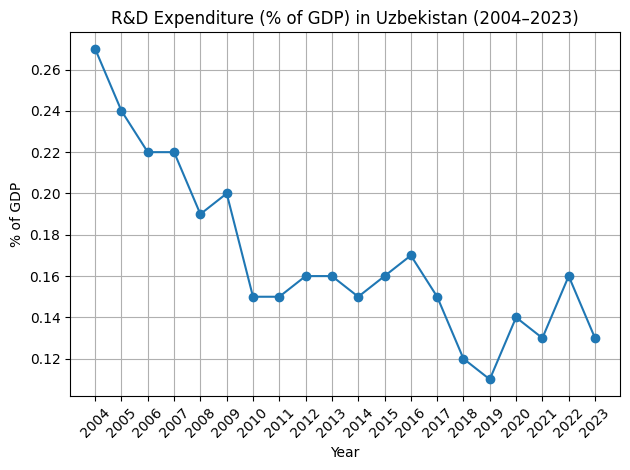
Science in Uzbekistan is developing under the Concept for the Development of Science until 2030, which aims to transform the country into an innovation- and technology-driven economy. The strategy focuses on increasing R&D funding, strengthening private-sector participation, modernizing laboratories, and expanding innovation infrastructure such as the Yashnabad Technopark. At the same time, challenges remain, including relatively low R&D expenditure (0.13% of GDP in 2023) and the need to ensure effective commercialization and global scientific integration.
Обзор: The system of science in Uzbekistan
The President of Uzbekistan has approved the Concept for the Development of Science until 2030, aimed at guiding the country toward an innovative and high-technology economy. The document sets the task of accelerating scientific development, modernizing research infrastructure, training young researchers, and actively attracting investment in research and development. An important part of the strategy is the creation of an effective science management system: a national ranking of scientific organizations is being introduced, self-governance within research institutions is being improved, and partnerships between the state and scientific organizations are being strengthened.
The strategy envisions a significant increase in science funding: by 2025, total expenditures are expected to grow sixfold, and by 2030—tenfold. The share of the private sector will also expand substantially: private investment in scientific research is expected to reach 20% by 2025 and 30% by 2030. To support innovation, the strategy includes the creation of venture funds and the development of modern research infrastructure—new laboratories, expansion of the Yashnabad Technopark, and increased spending on technological innovation.
Major emphasis is placed on developing human capital: the plan aims to rejuvenate the scientific community, increase the number of young researchers holding academic degrees, and launch an Academic Mobility Program that will allow talented youth to undertake short-term training abroad and access modern scientific equipment. The digital transformation of science is also essential—Uzbekistan will create a national science portal, introduce researcher and institution rankings, and implement a unified electronic system for PhD and DSc training.
The decree also simplifies the recognition of foreign academic degrees and titles, establishes regular international audits of scientific organizations, and assigns responsibility for scientific development to regional authorities and sectoral ministries. Additionally, the strategy is supported by international partners: the World Bank is providing funding to modernize the national innovation system and strengthen the country’s scientific capacity.: https://lex.uz/docs/5057390
Research and development expenditure, percent of GDP
The latest value from 2023 is 0.13 percent, a decline from 0.16 percent in 2022. In comparison, the world average is 0.43 percent, based on data from 27 countries. Historically, the average for Uzbekistan from 2000 to 2023 is 0.19 percent. The minimum value, 0.11 percent, was reached in 2019 while the maximum of 0.36 percent was recorded in 2000. See the global rankings or world map for that indicator or use the country comparator to compare trends over time(figure 1). https://www.theglobaleconomy.com
Forms of financing:
State scientific and trends over time technical programs — 1-3 years, basic and applied research. Commercialization program-supports the transition from research to market (prototype, R & D, marketing).
- Grants for young scientists-funding projects and internships up to 35 years old.
- Support for startups through IT Park-acceleration, grants up to 500 million soums https://it-park.uz
- InnoFund (Uzbekistan Science and Innovation Support Foundation)
- MUNIS Project (with the World Bank) – up to $600,000 per team (2023-2026).https://wbgrants.uz
Key authorities:
- Ministry of Higher Education, Science and Innovation of the Republic of Uzbekistan – forms and implements scientific, technological and innovative policies https://www.edu.uz/ru
- The Agency for Innovative Development under the Ministry of Higher Education, Science and Innovation provides comprehensive development of society and state life in the field of innovative and scientific and technical development of the Republic of Uzbekistan, increasing the intellectual and technological potential of the country; https://gov.uz/ru/innovation
- The Foundation for Science and Innovation Development provides funding for applied and fundamental research and commercialization.https://innofund.uz/
- Mirzo Ulugbek Innovation Center-promotes startups and research and development ( R & D) projects.
- The Academy of Sciences of the Republic of Uzbekistan is a leading center of fundamental science https://academy.uz (figure 2)
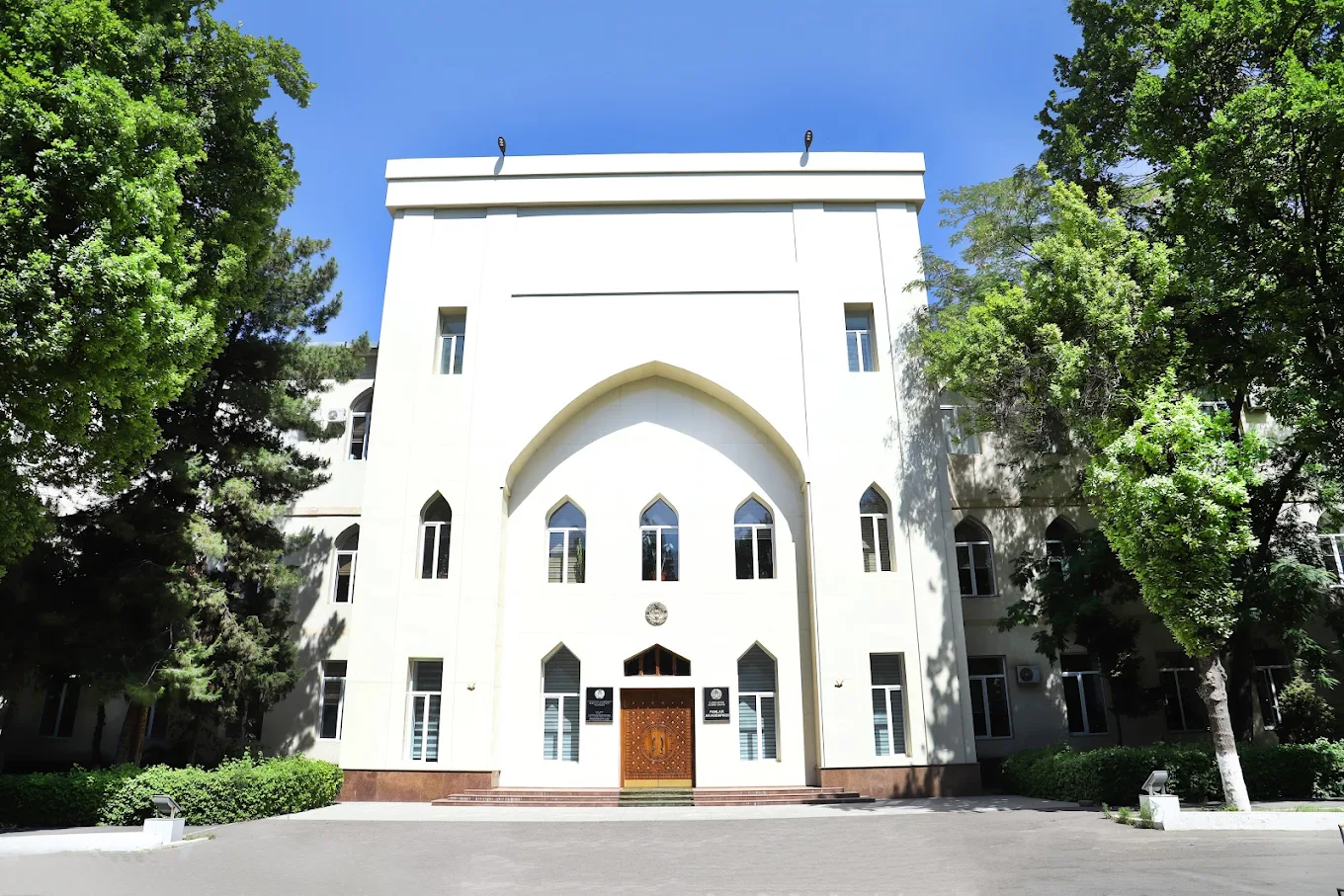
It is a leading scientific institution in the country. It was founded in 1943.Coordinates a network of research institutes (more than 30).Main directions: chemistry, physics, mathematics, geology, medicine, agriculture.
ANRUz functions:
- Conducting basic research.
- Scientific expertise of projects and programs.
- Training of scientific personnel (postgraduate and doctoral studies).
- Support for international cooperation (including through TWAS, UNESCO, DAAD).
- Organization of scientific events, publications, and journals
Universities of Uzbekistan
Uzbekistan has a large number of higher education institutions. As of 2025, their total number is 201. Higher education institutions are divided into:by form of ownership — state, non — state, and foreign;by organizational type-academies, branches, institutes, and universities. studyin-uzbekistan.uz/universitiesю Of these, about 101 are state — owned, over 70 are private, and about 30 are branches of foreign universities. Education is divided into three levels: Bachelor’s, Master’s and doctoral studies (PhD and DSc).
Training is conducted in Uzbek, Russian and English. A credit module system (similar to the European ECTS) is being implemented, academic autonomy of universities is being expanded, and international partnerships are actively developing.
Special attention is paid to digitalization, innovation, cooperation with industry and practice-oriented training. Higher education institutions are given greater independence in the development of curricula, personnel policy and budget formation.
Leading universities in Uzbekistan
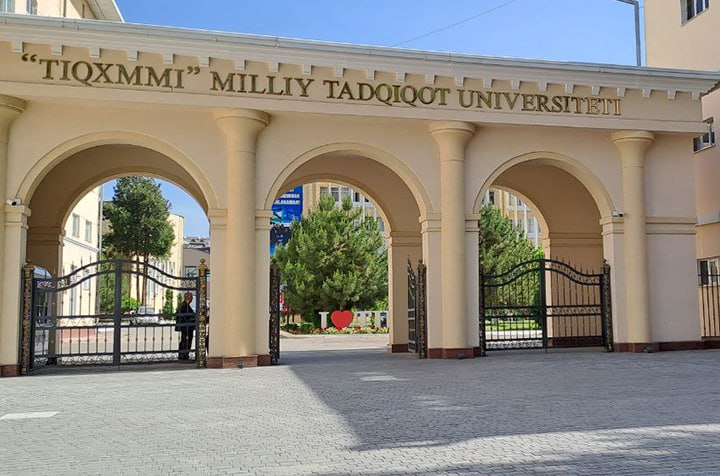
- National University of Uzbekistan (NUUz)Website: https://nuu.uz
The oldest and largest university in Uzbekistan. A flagship center for fundamental sciences, mathematics, physics, biology, geology, and humanities. One of the main hubs of academic research in the country. - Tashkent University of Information Technologies (TUIT) Website: https://tuit.uz
Leading IT and telecommunications university of Uzbekistan. Specializes in computer science, cybersecurity, software engineering, AI, and digital communications. Has branches in all regions. - Tashkent State University of Economics (TSUE)Website: https://www.tsue.uz
Top economic university of the country, focusing on economics, finance, digital economy, management, business analytics, and economic policy. - University of World Economy and Diplomacy (UWED)Website: https://www.uwed.uz
Operates under the Ministry of Foreign Affairs. A prestigious institution specializing in international relations, diplomacy, global economics, law, and strategic governance. - Westminster International University in Tashkent (WIUT)Website: https://www.wiut.uz
A leading international British university in Central Asia. Offers programs in business, economics, finance, management, IT, and social sciences. Known for high academic standards. - Tashkent Institute of Irrigation and Agricultural Mechanization Engineers (TIIAME – National Research University)Website: https://tiiame.uzUzbekistan’s leading institution in water resources, irrigation engineering, hydrology, agriculture technologies, and environmental management. Strong in applied research and field-based training.(figure 2)
- Tashkent State Technical University (TSTU)Website: https://tdtu.uz
Major engineering and technical university specializing in energy, mining, mechanical engineering, industrial technologies, and applied sciences. - Tashkent State University of Law (TSUL)Website: https://www.tsul.uz
National leader in legal education. Programs include civil law, international law, human rights, public policy, and judicial training. - Tashkent State Pedagogical University (TSPU)Website: http://www.tdpu.uz
- Key institution for teacher education, psychology, pedagogy, social sciences, and educational technologies. Largest pedagogical university in the country.
- Uzbek State World Languages University (USWLU)Website: http://www.uzswlu.uz
Major university for linguistics, translation studies, international languages, philology, and teacher training in foreign languages.